

iPrompti
HomeCategoriesCommunity

✦ Prompt Detail

The Living Portrait

Posted August 23, 2026
✦ Copyable Prompt

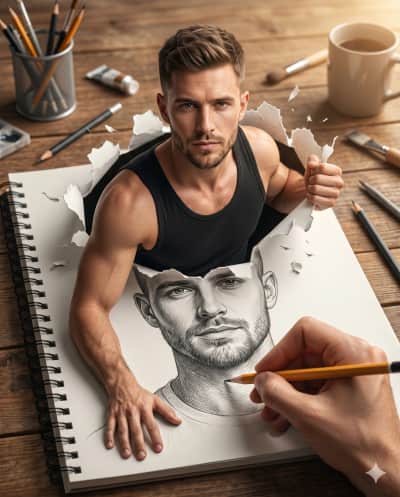
Create a cinematic, hyper-realistic 3D illustration blending photorealism with magical realism. Use the uploaded reference image strictly for facial identity and likeness. The scene shows a handsome man dramatically emerging from the torn pages of a spiral-bound sketchbook placed on a warm rustic wooden artist’s desk, as if the pencil drawing is becoming real. Identity & Appearance: Preserve the subject’s exact facial identity from the reference image, including facial structure, jawline, beard shape and density(if present in the reference image), hairstyle length and shape, skin tone, eye shape, nose proportions, and natural facial details. Do not beautify or alter the identity. His expression should be slightly intense, focused, and serious, but not angry, sad, or aggressive. His gaze is directed straight toward the viewer. He wears a fitted black sleeveless tank top, revealing toned shoulders and arms with realistic skin texture. Main Concept: The sketchbook page contains an ultra-detailed graphite pencil portrait of the same man, drawn with fine cross-hatching, realistic shading, visible pencil strokes, and strong facial detail. The man is breaking through the drawing into the real world. The paper around the portrait is ripped open into an irregular torn hole, with rough paper fibers, curled edges, and layered torn texture. Pose & Action: The man emerges from the sketchbook in a powerful but natural motion. His right hand grips the ripped paper edge and pulls it outward. His left arm extends forward and rests naturally on the sketchbook surface, stabilizing his body as he rises from the page. Keep the anatomy realistic, with correct arm proportions, natural hand structure, and believable interaction with the paper. Small torn paper fragments and paper fibers float around the opening, creating motion, depth, and a strong illusion of transformation. Foreground Artist Hand: In the lower foreground, show a realistic human hand holding a sharpened yellow wooden pencil. The pencil tip is close to the neckline area of the graphite portrait, as if the artist is still sketching the drawing while it becomes real. The hand should look natural, properly scaled, and slightly closer to the camera, adding a meta-illusion effect without blocking the main subject. Environment & Desk Details: The spiral-bound sketchbook lies open on a rustic wooden artist’s desk with visible warm wood grain, scratches, and natural imperfections. The spiral binding must be clearly visible along the left side of the sketchbook. Around the scene, include softly blurred artist tools: a metal pencil holder filled with pencils and brushes, loose graphite pencils, a small paint tube, a ceramic coffee mug, and scattered drawing tools. Keep these background objects secondary and softly out of focus so the man, torn paper, and sketchbook remain the main focus. Lighting: Use warm golden cinematic light streaming from the upper right side, illuminating the man’s face, shoulders, arms, and the torn paper edges. Add soft highlights on the skin, paper fibers, pencil strokes, and desk texture. Create gentle shadows across the sketchbook and desk for depth. Add subtle rim lighting around the torn paper and the subject’s silhouette to enhance separation and realism. Materials & Texture: Render highly detailed torn paper fibers, curled page edges, graphite shading, visible pencil strokes, realistic skin pores, natural facial texture, matte cotton texture on the black tank top, and detailed rustic wood grain. Avoid plastic-looking skin, overly smooth textures, cartoon styling, or fake CGI shine. Composition & Camera: Vertical 4:5 aspect ratio. Eye-level cinematic camera angle. The subject emerging from the sketchbook should occupy roughly 65–75% of the frame. Keep the face, hands, torn paper, pencil, and spiral binding clearly visible. Use shallow depth of field: sharp focus on the man, torn paper, graphite portrait, and foreground pencil interaction, with background art supplies softly blurred. Maintain a balanced composition with strong visual depth and no awkward cropping. Atmosphere & Style: The image should feel like a magical realism moment frozen between imagination and reality, where fine-art pencil drawing transforms into a living person. The final result must be cinematic, immersive, dramatic, premium, and visually striking, combining photorealistic 3D rendering with realistic graphite illustration details. Quality: Ultra-detailed, photorealistic textures, realistic anatomy, cinematic color grading, high dynamic range, crisp focus, studio-quality rendering, 8K-level detail, professional fantasy editorial artwork. Negative Instructions: Do not change the subject’s identity. Do not make the expression angry, sad, scary, or overly dramatic. Do not crop the face or hands. Do not hide the spiral binding. Do not make the paper tear look flat. Do not make the pencil hand too large or unnatural. Do not add extra text, logos, watermarks, random symbols, distorted anatomy, extra fingers, or cartoonish effects.

Share this prompt
✦ Model or Tool
Gemini
✦ Tags

✦ Prompting Guide

Usage Guide & Styling Tips for "The Living Portrait"

This prompt is engineered specifically for Surrealism / Photorealism style transformations. Every prompt in the iPrompti library is pre-tested across multiple lighting environments and photo subjects to ensure high-fidelity outputs in Google Gemini, ChatGPT (DALL·E 3), and Midjourney without requiring complex manual prompt re-writing.

Result & Styling

The "The Living Portrait" prompt is engineered to generate a unique visual styling. Outputs a high-fidelity creative transformation featuring vivid color accuracy, sharp detail definitions, and optimized highlight-shadow balance. It boosts detail clarity while retaining natural lighting. It works by combining advanced lighting tags, color science parameters, and composition formulas specific to Surrealism / Photorealism styles. When processed by Gemini/ChatGPT, it optimizes contrast ratios and applies professional color grading to deliver a polished, premium aesthetic that stands out on any feed.

Best Reference Photo

For the absolute best results with "The Living Portrait", your reference photo choice is critical. Works well with any clear, high-resolution portrait or subject photo that has defined contours and balanced exposure. Avoid low-resolution or blurry uploads. High-contrast, sharp subject definitions, and clear directional lighting enable the generative model to map textures and features accurately. Avoid photos with motion blur, extreme angles, or poor lighting, as they degrade the final styling application.

Pro Prompting Tips

  • For enhanced depth, specify a particular camera lens (e.g., 85mm f/1.4 or 35mm) to guide the generator's depth of field.
  • If the colors feel too saturated, add keywords like 'muted color science' or 'pastel color palette' at the end of the prompt.
  • Pair this prompt with simple, structured outfits to avoid overly complex or distorted clothing folds in the final render.

Common Mistakes to Avoid

  • Altering the core camera parameters in the prompt, which can break the specific film tone and grain consistency.
  • Adding too many conflicting lighting terms (e.g., combining 'soft studio light' and 'harsh midday sun') which confuses the generator.

Prompt Anatomy

This prompt is structured around a clear Subject, an Aesthetic Style, specific Lighting Instructions, and Camera settings to ensure consistent AI generation.

Recommended Settings

Aspect Ratio: 16:9 or 9:16 (for social). Model: Midjourney v6 / DALL·E 3 / Gemini Advanced. Stylize: Medium/High.

✦ Quality Signal

Ratings & Reviews

Crowdsourced ratings and real user results for "The Living Portrait".

Rate & Review this Prompt

Select rating
0/300

Community Reviews (0)

Sort by:
Loading reviews...

✦ Similar Styles

Related Prompts

Surrealism / Photorealism

New

The Living Portrait

Create a cinematic, hyper-realistic 3D illustration blending photorealism with magical realism. Use the uploaded reference image strictly for facial identity and likeness. The scene shows a handsome man dramatically emerging from the torn pages of a spiral-bound sketchbook placed on a warm rustic wooden artist’s desk, as if the pencil drawing is becoming real. Identity & Appearance: Preserve the subject’s exact facial identity from the reference image, including facial structure, jawline, beard shape and density(if present in the reference image), hairstyle length and shape, skin tone, eye shape, nose proportions, and natural facial details. Do not beautify or alter the identity. His expression should be slightly intense, focused, and serious, but not angry, sad, or aggressive. His gaze is directed straight toward the viewer. He wears a fitted black sleeveless tank top, revealing toned shoulders and arms with realistic skin texture. Main Concept: The sketchbook page contains an ultra-detailed graphite pencil portrait of the same man, drawn with fine cross-hatching, realistic shading, visible pencil strokes, and strong facial detail. The man is breaking through the drawing into the real world. The paper around the portrait is ripped open into an irregular torn hole, with rough paper fibers, curled edges, and layered torn texture. Pose & Action: The man emerges from the sketchbook in a powerful but natural motion. His right hand grips the ripped paper edge and pulls it outward. His left arm extends forward and rests naturally on the sketchbook surface, stabilizing his body as he rises from the page. Keep the anatomy realistic, with correct arm proportions, natural hand structure, and believable interaction with the paper. Small torn paper fragments and paper fibers float around the opening, creating motion, depth, and a strong illusion of transformation. Foreground Artist Hand: In the lower foreground, show a realistic human hand holding a sharpened yellow wooden pencil. The pencil tip is close to the neckline area of the graphite portrait, as if the artist is still sketching the drawing while it becomes real. The hand should look natural, properly scaled, and slightly closer to the camera, adding a meta-illusion effect without blocking the main subject. Environment & Desk Details: The spiral-bound sketchbook lies open on a rustic wooden artist’s desk with visible warm wood grain, scratches, and natural imperfections. The spiral binding must be clearly visible along the left side of the sketchbook. Around the scene, include softly blurred artist tools: a metal pencil holder filled with pencils and brushes, loose graphite pencils, a small paint tube, a ceramic coffee mug, and scattered drawing tools. Keep these background objects secondary and softly out of focus so the man, torn paper, and sketchbook remain the main focus. Lighting: Use warm golden cinematic light streaming from the upper right side, illuminating the man’s face, shoulders, arms, and the torn paper edges. Add soft highlights on the skin, paper fibers, pencil strokes, and desk texture. Create gentle shadows across the sketchbook and desk for depth. Add subtle rim lighting around the torn paper and the subject’s silhouette to enhance separation and realism. Materials & Texture: Render highly detailed torn paper fibers, curled page edges, graphite shading, visible pencil strokes, realistic skin pores, natural facial texture, matte cotton texture on the black tank top, and detailed rustic wood grain. Avoid plastic-looking skin, overly smooth textures, cartoon styling, or fake CGI shine. Composition & Camera: Vertical 4:5 aspect ratio. Eye-level cinematic camera angle. The subject emerging from the sketchbook should occupy roughly 65–75% of the frame. Keep the face, hands, torn paper, pencil, and spiral binding clearly visible. Use shallow depth of field: sharp focus on the man, torn paper, graphite portrait, and foreground pencil interaction, with background art supplies softly blurred. Maintain a balanced composition with strong visual depth and no awkward cropping. Atmosphere & Style: The image should feel like a magical realism moment frozen between imagination and reality, where fine-art pencil drawing transforms into a living person. The final result must be cinematic, immersive, dramatic, premium, and visually striking, combining photorealistic 3D rendering with realistic graphite illustration details. Quality: Ultra-detailed, photorealistic textures, realistic anatomy, cinematic color grading, high dynamic range, crisp focus, studio-quality rendering, 8K-level detail, professional fantasy editorial artwork. Negative Instructions: Do not change the subject’s identity. Do not make the expression angry, sad, scary, or overly dramatic. Do not crop the face or hands. Do not hide the spiral binding. Do not make the paper tear look flat. Do not make the pencil hand too large or unnatural. Do not add extra text, logos, watermarks, random symbols, distorted anatomy, extra fingers, or cartoonish effects.

Copy

By @iPrompti

✦ Browse

Explore More Categories